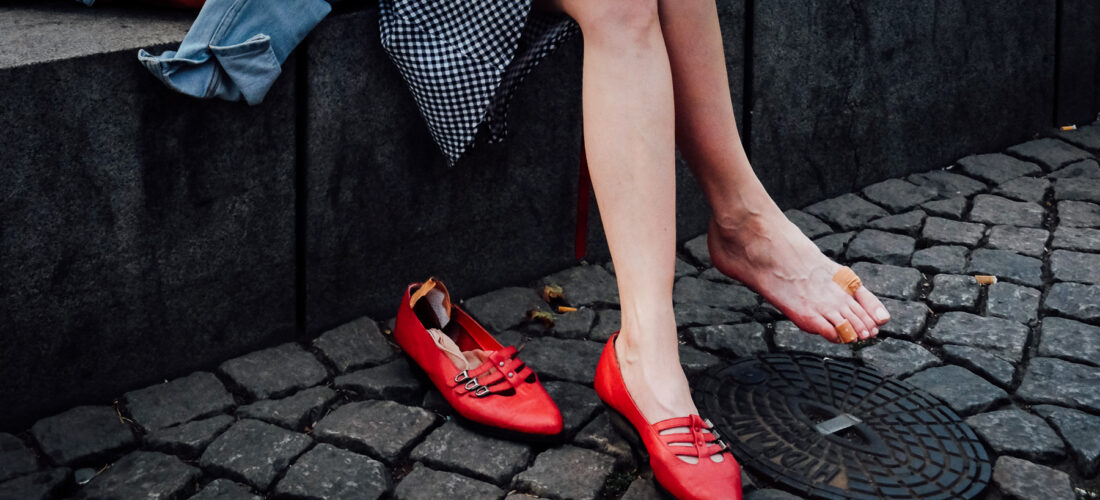
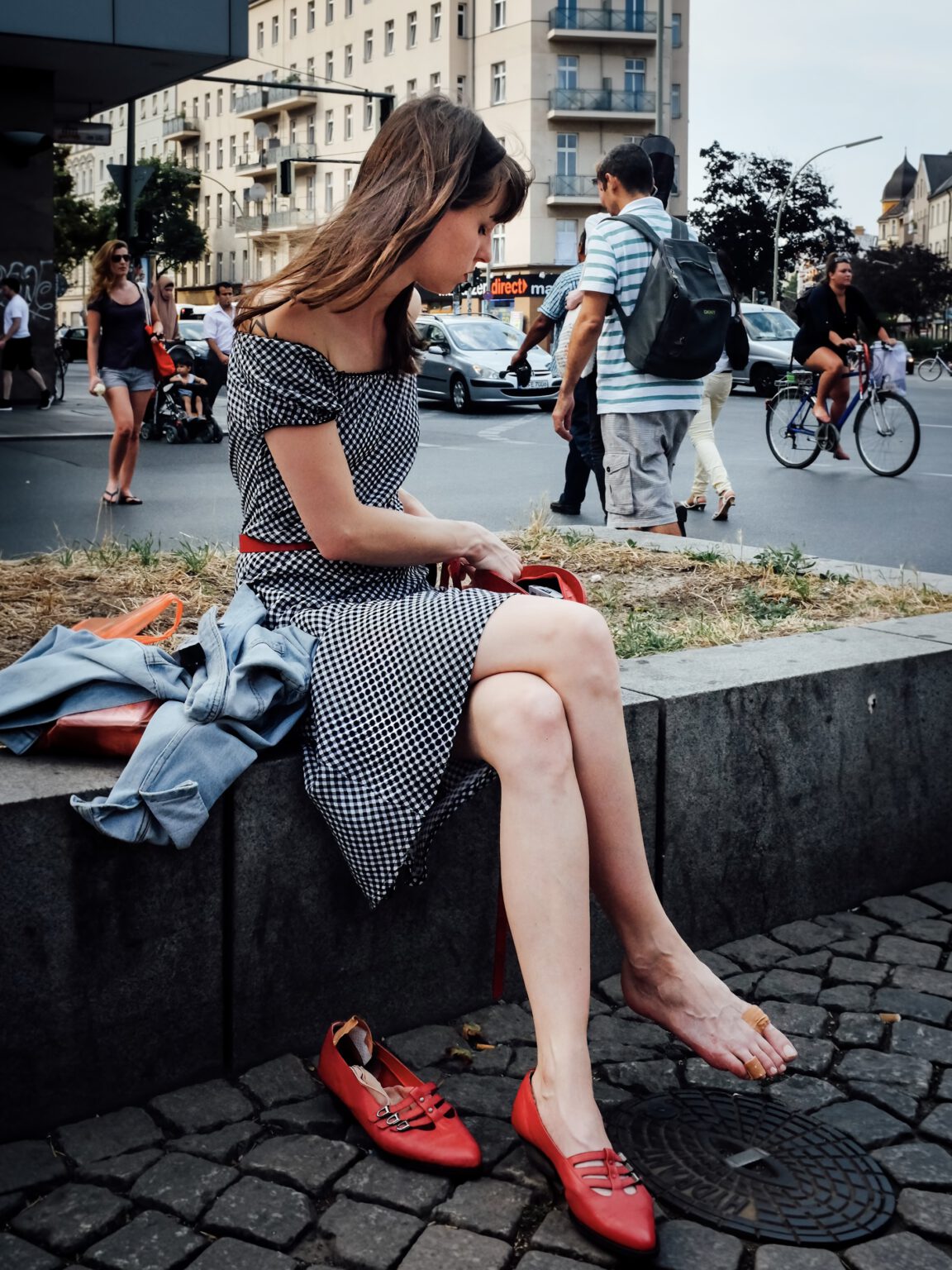
Street photography does not always give you time. I saw the scene and knew at once that it would be gone a moment later. The young woman sitting on the wall, the checked dress, the red shoes, her posture, the people and traffic behind her. For a brief moment, all these elements had come together to form a picture.
So I raised the camera and pressed the shutter. There was no time to compose carefully or check the edges of the frame. Had I done so, the moment would probably have passed. That is part of street photography. Sometimes you have to choose between a perfect composition and the moment itself.
I got the moment, but I did not quite get one of the shoes. I had cut it off at the bottom of the frame. It was a small thing, really. I still liked the photograph enough to include it in an exhibition some time later, and there I noticed something interesting. The missing part of the shoe did not bother anyone. Most people probably never noticed it.
There is an old saying among photographers that if people are looking at the edges of your photograph rather than the subject, you have done something wrong. By that measure, there was nothing wrong with my photograph. The problem was that I kept looking at the edge.
I knew what was missing. Whenever I looked at the picture, sooner or later my eye would find its way back to that shoe. Perhaps this is an occupational hazard for photographers. In our own pictures, we do not only see what worked. We also see the picture we almost made.
Many years later, I can suddenly get those missing few centimetres back. Using the new AI features in iOS 27, I had the missing part of the shoe added. It took only a moment. The shoe, the cobblestones, the light and the perspective all fitted so naturally that it looked as though nothing had ever been missing. I found it fascinating and a little unsettling.
Photography, of course, has never been a neutral record of reality. When I take a photograph, I choose the framing, the moment and the point of view. Later I make decisions about brightness, contrast and colour. Even in the darkroom decades ago, I dodged, burned and retouched my pictures. But this feels different. I am no longer changing what my camera recorded. I am adding something it did not record at all.
Of course the shoe was there. Its existence is not an invention. But the AI cannot know exactly what the missing part looked like, the angle at which it sat or how the light fell on it. It is not recovering lost information. It is creating something plausible. The remarkable thing is that you cannot tell.
Perhaps that is what makes me uneasy. In the past, altering a photograph usually left some trace or at least required considerable effort. Today, a phone can turn the photograph I actually took into the photograph I wish I had taken. In a way, AI has given me the time I did not have when I took it. Time to check the frame, to move the camera a few centimetres, to make a composition that the actual moment did not allow.
I like the result. At last, the shoe no longer bothers me. And now, strangely enough, I find myself wondering whether I still want to show the photograph this way.
The original was never really broken. It hung in an exhibition, people looked at it, and the cropped shoe did not matter. Perhaps that small imperfection belonged to the fleeting nature of the moment more than I was willing to admit. The new version is more complete, but is it still the same photograph?
Perhaps this is the question AI is beginning to ask of photography. It is not whether we can perfect our pictures. Clearly, we can. The question is whether we should, simply because we can.
I photographed the moment. I did not photograph the whole shoe.


There is a certain irony in writing about my uneasiness with AI and photography with the help of AI. The thoughts and the experience are mine, but as English is not my first language, I used AI to help me put them into words. I am not quite sure how I feel about that either.